


The State of Palestine needs sustained prayer. People in Gaza and the West Bank continue to face severe suffering, displacement, restricted movement, economic hardship, and fear. In Gaza, many families are living with damaged services, limited access to safe water, hunger, grief, and uncertainty. In the West Bank, including East Jerusalem, Palestinians continue to face military operations, movement restrictions, demolitions, settler violence, and pressure on land and livelihoods.
For the small Christian communities in these places, the burden is not simply survival. They need grace to remain faithful to Christ, care for their families, serve their neighbours, worship together, and resist despair when the future feels painfully uncertain.
A 15-point Gaza roadmap announced on 31 July 2026 proposed phased steps involving Hamas weapons, Israeli military withdrawal, civilian administration and policing, international involvement, humanitarian access, and reconstruction. Hamas said it accepted the framework. By 9 August, however, Israeli Prime Minister Benjamin Netanyahu had rejected the proposal in its existing form and said Israel would not withdraw until Hamas had been fully disarmed. The plan therefore remains a contested negotiating framework, not a peace settlement that has been carried out.
Prayer Burden at a Glance
Pray for civilians in Gaza and the West Bank who are living with displacement, hunger, damaged services, restricted movement, grief, and fear. Ask God to open dependable paths for humanitarian help and to protect people whose lives remain vulnerable.
Pray for truthfulness, restraint, justice, and wisdom among Palestinian and Israeli leaders and all who hold military, political, or security power. Pray for hostages, detainees, prisoners, missing people, and their families.
Pray that negotiations over Gaza’s future would lead to genuine, verifiable steps that protect civilians, address weapons and military withdrawal, provide responsible civilian government, and make reconstruction possible. Pray especially for historic Palestinian Christian communities to remain steadfast in Christ and faithful in their witness.
Last verified: 11 August 2026
Why the State of Palestine Needs Prayer Now
Severe civilian suffering, continuing insecurity, pressure on homes and livelihoods, and the vulnerability of small Christian communities all call for sustained and careful prayer.
Daily life in Gaza and the West Bank remains marked by severe suffering and prolonged insecurity. Humanitarian reporting in mid- and late July described widespread displacement in Gaza, badly damaged essential services, inadequate shelter, strained health and sanitation systems, and continuing obstacles to humanitarian work. Repeated displacement, shortages, insecurity, and restricted access have left civilians especially vulnerable.
Increased humanitarian assistance and commercial traffic brought some improvement in food access during July, but severe food insecurity remained widespread and the gains were fragile. Livelihoods and essential services had not recovered, and many families remained dependent on outside help.
The West Bank also needs sustained prayer. Military operations, demolitions, settler violence, settlement expansion, movement restrictions, and displacement continue to affect homes, livelihoods, schools, health care, worship, access to water, and the ability of families to reach their land.
For Christians, this is not simply a story of direct anti-Christian persecution. Palestinian Christians are a small, historic minority whose lives are bound up with the suffering around them. They share the wider burdens of insecurity, restricted movement, economic strain, displacement, and uncertainty. At the same time, their small numbers mean that emigration, loss of livelihoods, family separation, and prolonged instability can have an especially serious effect on the future of local churches and Christian communities.
Christians should therefore pray with both grief and hope: grief for the wounded, displaced, hungry, bereaved, detained, and afraid; and hope because Christ remains Lord over rulers, wars, borders, churches, and families. Political agreements can fail and injustice can continue, but the church’s hope does not rest on a diplomatic settlement. Christ is able to preserve His people, sustain faithful witness, and draw sinners to Himself even in a deeply wounded land.
Country Snapshot
A brief orientation to Palestine’s United Nations status, the areas named in this guide, current Palestinian leadership, and the setting of historic Christian communities.
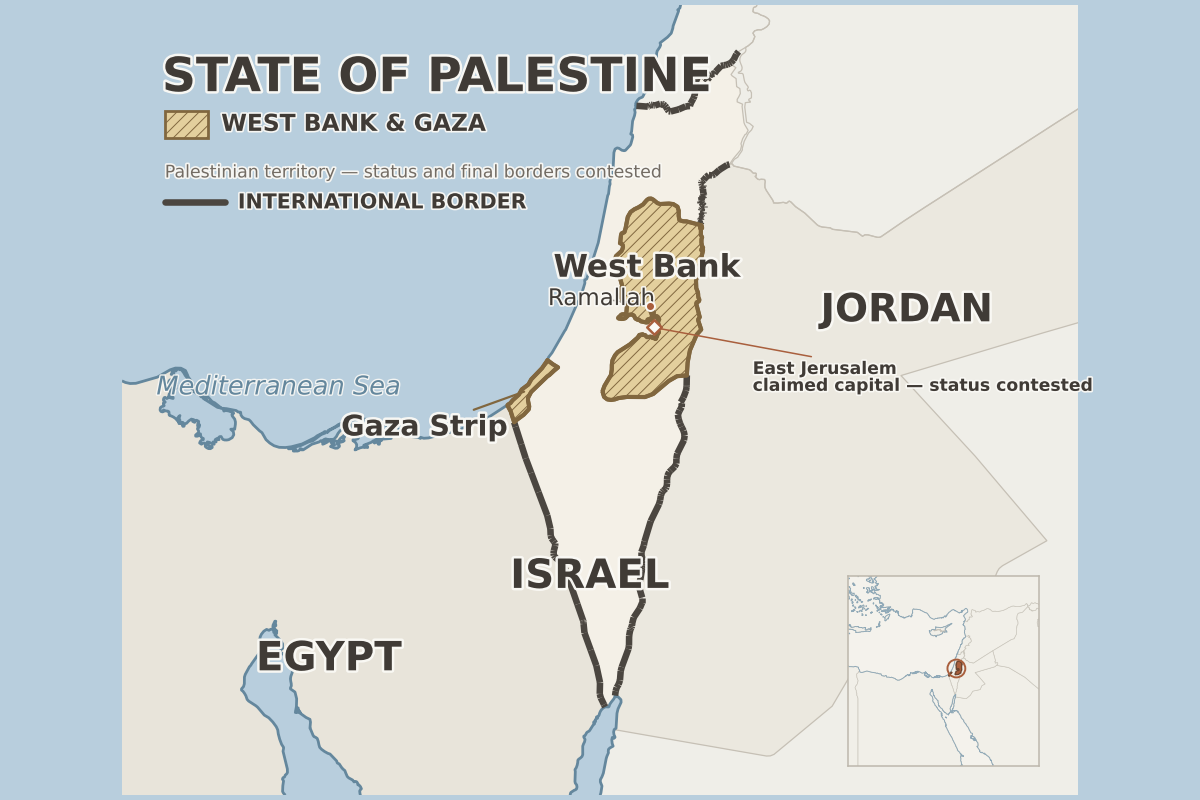
At the United Nations, the State of Palestine has non-member observer-state status, which is short of full UN membership. It is generally understood to refer to the West Bank, including East Jerusalem, and the Gaza Strip, although questions of control, sovereignty, borders, and final political status remain disputed. For clarity, this guide names Gaza, the West Bank, East Jerusalem, and individual towns when a particular place is meant.
The population is overwhelmingly Muslim, while Christians form a small minority with deep historical roots. Christian Palestinians are found especially in places such as Bethlehem, Beit Jala, Beit Sahour, Ramallah, Taybeh, East Jerusalem, and Gaza City. Exact Christian population figures should be treated cautiously because war, displacement, migration, and the small size of these communities can change estimates quickly.
Government and control remain fragmented. The Palestinian Authority exercises limited civil authority in parts of the West Bank, while Israeli authorities retain extensive security, movement-control, and administrative powers in many areas.
Palestinian leaders continue to state that Gaza should remain part of the State of Palestine and that Palestinian institutions should ultimately exercise civilian authority there. Hamas announced in July that it was prepared to transfer civilian administration to a Palestinian technocratic arrangement, but that announcement did not itself transfer political or security authority.
The later Gaza roadmap also proposed new arrangements for civilian government, policing, verification, and international security involvement. As of 11 August, those proposals had not produced a completed transfer of authority. Gaza’s political and security future therefore remains unsettled.
Spiritual and Practical Challenges Affecting Christians and Churches
Christians share many of the dangers and hardships around them, while their small numbers make prolonged disruption especially serious for church life, families, livelihoods, and witness.
Christians in the State of Palestine are not best understood only through direct anti-Christian persecution. They experience many of the same dangers, restrictions, and economic hardships as their Muslim neighbours. Because Christian communities are small, however, prolonged disruption can have an especially serious effect on church and community life.
Movement, worship, and pastoral care
Movement restrictions can affect worship, family life, employment, pilgrimage, pastoral care, schooling, and access to holy sites in and around Jerusalem. When roads are blocked, permits are difficult to obtain, or travel becomes unsafe or expensive, the consequences reach far beyond inconvenience. Families may struggle to meet, pastors may find it harder to care for people, and ordinary patterns of church, work, and school life can be disrupted.
Land, livelihoods, and community pressure
Settler violence and intimidation, settlement expansion, and difficulty accessing land affect communities across the West Bank, including Christian towns. Taybeh has faced continuing concern over violence, land access, and the possible establishment of a nearby settler outpost.
These pressures are not experienced only by Christians, and not every incident should be described as hostility toward Christianity. Their particular significance for Christian communities lies in the vulnerability of small populations whose homes, farms, livelihoods, churches, schools, and future in the land are closely connected.
Gaza’s exceptionally vulnerable Christian community
Gaza’s Christian community is very small. War, displacement, damaged infrastructure, shortages, trauma, and fear affect the wider population, but a small Christian community has little margin for prolonged loss. Even the death or departure of a modest number of people can affect families, congregations, pastoral care, Christian institutions, and the community’s long-term future.
Emigration, trauma, and faithful witness
Economic hardship, grief, insecurity, and uncertainty can strengthen the pressure to leave. Believers may also need wisdom where public Christian witness, interfaith family relationships, or questions concerning conversion are sensitive.
These realities should not be exaggerated or used to caricature Palestinian society. Christian and Muslim Palestinians often share neighbourhoods, grief, economic hardship, and national suffering. Christians nevertheless need prayer for courage, humility, protection, wisdom, and love as they seek to live faithfully before Christ.
Christian Life and Witness in the State of Palestine
Christian faithfulness is lived out through worship, family life, teaching, pastoral care, mercy, and gospel witness under severe and often exhausting pressures.
For many Palestinian Christians, faithfulness means carrying out ordinary Christian responsibilities under extraordinary strain. Families may try to attend worship while checkpoints, insecurity, or transport costs make travel difficult. Pastors and priests minister to people who have lost relatives, homes, income, or confidence about the future. Teachers try to keep children learning while parents wrestle with whether their families can remain.
Younger Christians may love their communities and churches while also considering emigration in search of safety, employment, or a more stable future for their families.
In Gaza, churches and Christian institutions have served not only as places of worship but also as places of shelter, care, education, and pastoral ministry. The prayer need is therefore larger than whether church services can continue. It includes whether families can remain together, children can be taught, elderly and disabled people can receive care, and believers can continue serving their neighbours when so much of ordinary life has been damaged.
In the West Bank, Christian life remains closely connected to family, land, schools, churches, businesses, pilgrimage, and local community. In Bethlehem, Beit Jala, Beit Sahour, Ramallah, Taybeh, East Jerusalem, and elsewhere, pressures involving movement, land, economic opportunity, and emigration can directly affect whether long-established Christian communities remain viable.
Taybeh gives one example of both vulnerability and endurance. Church leaders have expressed serious concern about land and community security, while Orthodox, Melkite Catholic, and Latin Catholic communities have continued shared pastoral activities for children.
Across the wider Palestinian Christian community, worship, pastoral care, Christian education, works of mercy, and service to neighbours continue despite grief and fear. These are genuine reasons for thanksgiving. At the same time, Christian heritage or church affiliation should not be confused with saving faith in Christ. Pray for deeper trust in Him, biblical faithfulness, holiness, and courageous gospel witness.
Recent Developments
Recent prayer needs include the contested Gaza roadmap, severe humanitarian conditions, continuing West Bank displacement and violence, and the endurance of vulnerable Christian communities.
-
31 July-10 August 2026
The Gaza roadmap became more sharply contested
A 15-point roadmap published on 31 July proposed phased measures involving Hamas weapons, Israeli military withdrawal, civilian administration and policing in Gaza, international involvement, humanitarian access, and reconstruction.
Hamas said it had accepted the framework. That did not mean Hamas had already disarmed or that the proposed political and security transition had begun.
By 9-10 August, Prime Minister Benjamin Netanyahu had publicly rejected the proposal in its existing form and said Israel would not withdraw from Gaza until Hamas had been fully disarmed. Hamas opposed that position and called on mediators to press Israel to follow the proposed framework.
The disagreement therefore concerns not only whether disarmament and withdrawal should occur, but also the order in which they would happen and how they would be verified.
As of 11 August, there was no verified completion of Hamas disarmament, an Israeli withdrawal under the roadmap, a transfer of full civilian authority in Gaza, or an operational international stabilization force.
Prayer significance: Pray for truthful dealing rather than propaganda, commitments that can be verified, protection of civilians during negotiations, restraint from further violence and reprisals, and arrangements that advance justice, security, responsible government, reconstruction, and peace without treating civilians as leverage.
-
24 July 2026
Severe food insecurity continued despite fragile gains
Increased humanitarian assistance and commercial traffic brought some improvement in food access, but severe food insecurity remained widespread. Damaged livelihoods, essential services, and household resources had not recovered, leaving recent gains vulnerable to renewed disruption.
Prayer significance: Pray for dependable access to food, adequate nutrition for children and mothers, restored livelihoods, honest distribution, and sustained help for families facing hunger.
-
Late July 2026
Humanitarian conditions remained severe in Gaza
Humanitarian reporting described continuing military activity, repeated displacement, crowded living conditions, damaged water and sanitation systems, shortages of essential supplies, and severe pressure on humanitarian services. Women and children faced particular health risks.
Prayer significance: Pray for safe shelter, clean water, sanitation, medical care, protection of civilians and aid workers, and reliable access for humanitarian assistance.
-
Late July 2026
Displacement and violence continued in the West Bank
Military operations, demolitions, settler violence, settlement expansion, and movement restrictions continued to cause displacement and damage homes, infrastructure, and livelihoods. These burdens remained serious even while much international attention focused on Gaza.
Prayer significance: Pray for displaced families, for restraint among those exercising force, for wrongdoing to be exposed and addressed, and for justice without revenge or collective punishment.
-
July 2026
Christian communities continued worship and pastoral service
Christian communities continued worship, education, pastoral care, and service to neighbours despite insecurity and economic pressure. In Taybeh, concern about land and community security remained serious, while church communities continued shared ministry to children.
Prayer significance: Give thanks for continuing worship and service. Pray that churches would remain grounded in Scripture, faithful to Christ, protected from fear and bitterness, and ready to care for suffering neighbours.
How to Pray
Pray for civilians, leaders, negotiations, historic Christian communities, faithful church ministry, repentance, reconciliation, and gospel fruit.
-
Pray for civilians and families in Gaza. Ask the Lord to protect people who are bereaved, wounded, displaced, disabled, elderly, pregnant, traumatised, or living without dependable shelter and essential services. Pray for sufficient food, clean water, sanitation, medicine, fuel, and humanitarian help.
-
Pray for Palestinians facing displacement and violence in the West Bank. Ask God to protect families affected by military operations, demolitions, settler violence, settlement expansion, movement restrictions, and loss of access to land and livelihoods. Pray for truthful investigation of wrongdoing, restraint, and justice without revenge.
-
Pray for hostages, detainees, prisoners, missing people, and their families. Ask God to protect them, expose abuse and deception, uphold humane treatment and justice, and bring truthful resolution wherever people remain captive, imprisoned, detained, or unaccounted for.
-
Pray for Palestinian and Israeli leaders and all who exercise power. Ask God to grant repentance, truthfulness, wisdom, justice, and restraint to political leaders, armed movements, security authorities, negotiators, judges, and others whose decisions affect civilian life. Pray against cruelty, corruption, revenge, collective blame, and the deliberate misuse of fear.
-
Pray for negotiations over Gaza’s future. Ask that proposals concerning weapons, military withdrawal, policing, civilian government, international security arrangements, humanitarian access, and reconstruction would be tested by truthful and verifiable action. Pray against renewed large-scale violence, reprisals, a security vacuum, and arrangements that leave civilians in greater danger.
-
Pray for the small historic Christian communities. Remember believers and churches in Gaza, Bethlehem, Beit Jala, Beit Sahour, Ramallah, Taybeh, East Jerusalem, and elsewhere. Ask the Lord to sustain those facing grief, isolation, economic strain, restricted movement, or pressure to leave.
-
Pray for pastors, teachers, parents, health workers, and ordinary believers. Ask God to give them holiness, courage, wisdom, patience, and endurance as they teach Scripture, proclaim Christ, comfort the grieving, care for the sick, serve displaced families, and love their neighbours.
-
Pray for repentance, reconciliation, and gospel fruit. Ask the Lord to turn Palestinians and Israelis away from hatred, contempt, lies, and revenge. Pray that He would preserve and purify His church, bring nominal Christians to genuine repentance and saving faith, draw unbelievers to Christ, and sustain His people in faithful obedience as they wait for the final justice and peace of His kingdom.
Give Thanks
Give thanks for continuing worship and service, practical mercy, restraint, and every sign of courage and neighbour love amid deep suffering.
-
Give thanks for continuing worship and Christian service. Christian worship, pastoral care, education, and church life continue in Gaza and the West Bank despite severe disruption and uncertainty.
-
Give thanks for care shown to vulnerable people. Churches, Christian institutions, clergy, teachers, health workers, parents, and ordinary believers continue caring for children, displaced people, the sick, the elderly, the grieving, and their wider communities.
-
Give thanks for humanitarian workers and local helpers. Many continue providing food, water, medical care, shelter, sanitation, protection, and practical help despite danger, shortage, obstruction, and exhaustion.
-
Give thanks for every genuine act of restraint and humane treatment. Civilian protection, truthful negotiation, and release from captivity should not be confused with a peace settlement that has not yet been achieved, but they are still reasons to thank God for mercy and restraint amid violence.
-
Give thanks for neighbour love, courage, integrity, and compassion. Receive such things as signs of God’s kindness and restraining mercy while continuing to pray about the grave burdens that remain.
Last Verified / Update Note
This note records the guide’s review date, the main burdens checked, and the fast-changing developments that may affect future prayer use.
Review Status
Reviewed for current prayer use
Gaza’s political and humanitarian situation; the 31 July roadmap; Hamas’s stated acceptance of that framework; Israel’s subsequent rejection of the proposal in its existing sequencing; unresolved questions concerning weapons, Israeli military withdrawal, civilian administration, policing, international security arrangements, and reconstruction; late-July humanitarian conditions; West Bank displacement, demolitions, settler violence, settlement expansion, and movement restrictions; Palestinian leadership and institutional positions; and pressures affecting Palestinian Christian communities.
Protection of civilians in Gaza and the West Bank; dependable food, water, shelter, sanitation, medical care, and humanitarian access; care for displaced and traumatised people; humane treatment and justice for people held captive, detained, imprisoned, or missing; truthful and restrained leadership; just and workable arrangements for Gaza’s future; protection of homes, land, and livelihoods; and faithful Christian witness amid grief, fear, economic pressure, and emigration.
Whether the 31 July roadmap is revised, replaced, or gains enough agreement to proceed; whether Hamas weapons are actually decommissioned under a verifiable arrangement; whether Israeli military withdrawal begins under an agreed framework; whether civilian government and policing arrangements materially change inside Gaza; whether the International Stabilization Force moves from preparation into substantive deployment; changes in humanitarian access and essential services; continuing West Bank displacement, demolitions, settler violence, settlement expansion, and movement restrictions; and pressures affecting historic Christian communities.
Political and diplomatic developments were checked through 11 August 2026. Humanitarian information retained in this guide is tied to the stated dates of the underlying reports and should not be read as an 11 August statistical snapshot. Official Palestinian, Israeli, and other political statements are used to establish the positions of those parties, not automatically as independent proof of disputed claims. Proposed arrangements concerning weapons, military withdrawal, civilian government, international security, and reconstruction are not described as completed unless implementation can be established.
Help keep this guide accurate and current
If you noticed a possible correction, broken link, or significant country update, please contact the Nations Prayer Directory so we can review it carefully.
Key Sources Consulted
Selected public sources used to verify the Gaza roadmap, official Palestinian and Israeli positions, humanitarian conditions, Christian-community life, and Palestine’s United Nations status.
Political, diplomatic, and official positions
- Associated Press — Israel rejects the Gaza roadmap, 10 August 2026
- Associated Press — Full text and explanation of the Gaza agreement, 31 July 2026
- United Nations / Board of Peace — Implementation of Security Council Resolution 2803 and Gaza transition arrangements
- Office of the President of the State of Palestine — Official Palestinian position on Gaza and Palestinian institutional responsibility
- Government of Israel — Official security position and stated conditions concerning Hamas and Gaza
- Al Jazeera — Hamas position on weapons, policing, and Gaza’s political transition
Humanitarian and institutional context
- United Nations Office for the Coordination of Humanitarian Affairs — Humanitarian Situation Report, 23 July 2026
- United Nations — Status of Palestine in the United Nations
Christian life and church context
Source Context
How to read the sources behind this guide in a highly contested and fast-changing political, humanitarian, and territorial setting.
Source Context
- Fast-changing Gaza negotiations. The Gaza roadmap is unusually volatile. This guide distinguishes between an announced or accepted proposal and measures that have actually been implemented. Israel’s 9 August rejection of the roadmap in its existing sequencing materially changed the situation and is therefore stated explicitly rather than hidden beneath general language about negotiations.
- Different political perspectives. Palestinian, Israeli, Hamas, and international bodies do not describe the conflict, security arrangements, land questions, humanitarian responsibility, or Gaza’s political future in the same way. Official sources are included so readers can see important positions more fairly, but an official statement is not treated as proof merely because a government or organization issued it.
- Humanitarian evidence. OCHA provides the principal humanitarian evidence used in this revision. Its latest situation report located during this review is from late July, so its figures and conditions remain dated accordingly. Israeli authorities dispute aspects of international humanitarian assessments and emphasize aid entry, distribution problems, security concerns, and alleged diversion. The guide therefore avoids turning contested aggregate claims into undated certainties while retaining well-supported descriptions of severe civilian need.
- West Bank evidence and terminology. OCHA documents substantial effects from Israeli military operations, demolitions, settlement expansion, movement restrictions, and settler violence. Israeli authorities emphasize counterterrorism needs, dispute some international characterizations of settler violence, and say illegal vigilante violence is condemned. The guide names documented pressures while avoiding the implication that every security action or settler-related incident is motivated by hostility toward Christianity.
- Christian-life evidence. Current public reporting on Palestinian Christian life is strongest in several historic church communities and institutions, particularly Gaza, Taybeh, Bethlehem-area communities, and Jerusalem. The guide uses those examples carefully and does not claim that they provide a complete picture of every Palestinian Christian congregation, tradition, or locality.
- Governance and international-force proposals. United Nations and Board of Peace material establishes the proposed structure for Palestinian administration, policing, decommissioning, Israeli withdrawal, and the International Stabilization Force. Subsequent troop commitments and preparations show that planning has advanced, but preparation is not treated as evidence that the proposed transition has been fully implemented.
- Stable background. Palestine’s United Nations status is a comparatively stable institutional fact and is therefore supported by United Nations material rather than fast-moving news reporting.
A Closing Prayer for the State of Palestine
A prayer for mercy, justice, restraint, faithful Christian witness, repentance, gospel fruit, and hope in Christ’s kingdom.


